
Reliability Planning for a 0.77-Inch OLED in Test and Measurement Gear
Test and measurement instruments are expected to keep working and keep looking the same for years, which makes the display a supply and consistency problem more than a performance problem. A 0.77-inch monochrome OLED with a 128x64 resolution and an SPI interface is a compact, low-power choice for an instrument readout, and its self-emissive nature removes the backlight as a wear-out mechanism. The questions that actually decide field reliability are long-term component availability, consistent appearance across a production run and the absence of the failure modes that plague other display technologies.
Key takeaways
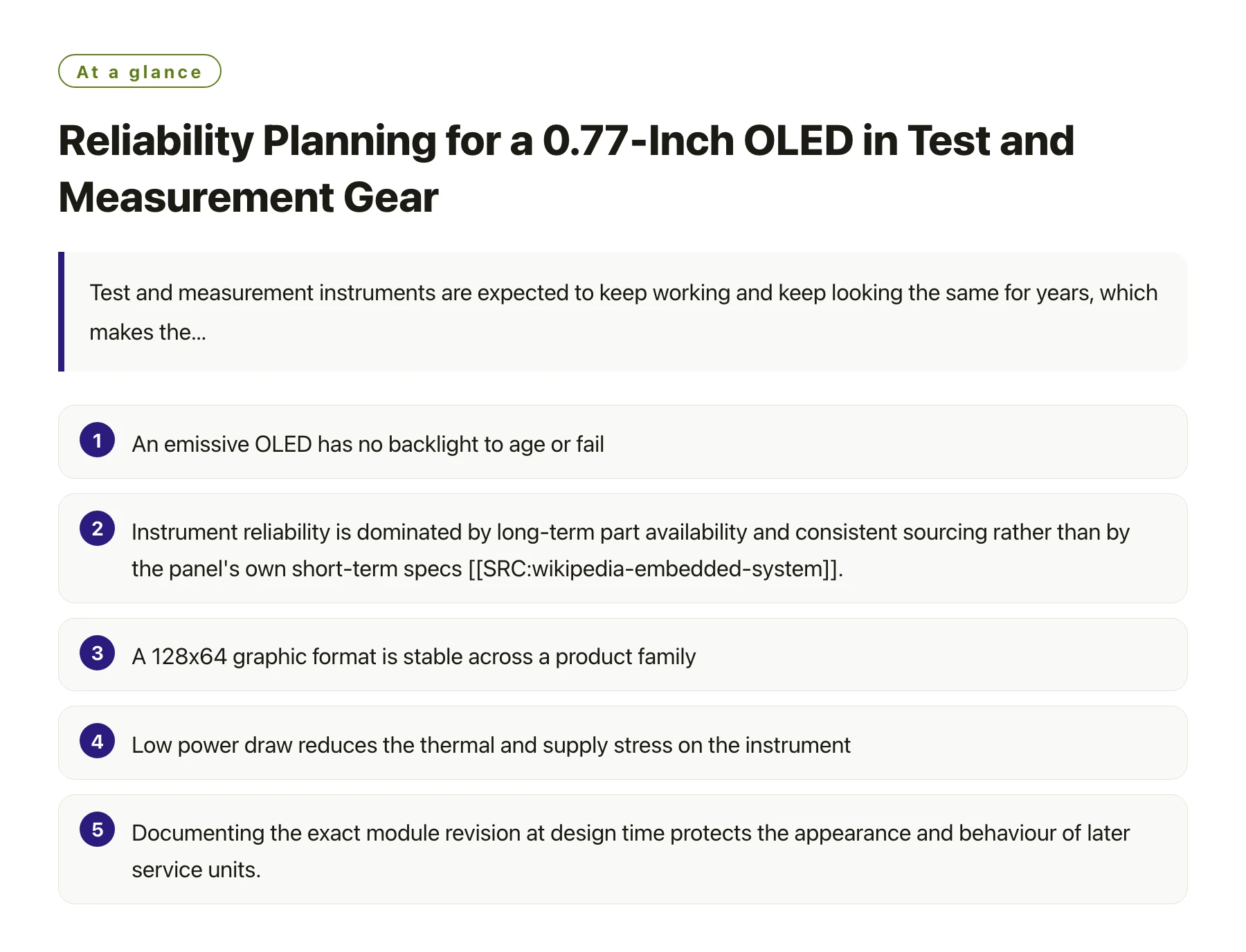
- An emissive OLED has no backlight to age or fail, which removes one of the classic display wear-out paths found in transmissive panels [1].
- Instrument reliability is dominated by long-term part availability and consistent sourcing rather than by the panel's own short-term specs [2].
- A 128x64 graphic format is stable across a product family, which helps keep firmware and tooling reusable over the instrument's life.
- Low power draw reduces the thermal and supply stress on the instrument, which indirectly supports overall reliability.
- Documenting the exact module revision at design time protects the appearance and behaviour of later service units.
When an instrument ships, the display is one component among many. Five years later, when a unit comes back for service or a new batch is built, the display is the component most likely to have drifted in availability or subtle appearance. Planning for that future is the core of reliability work on a small instrument panel.
The OLED's advantages for this role are practical rather than spectacular. Being self-emissive, it does not depend on a backlight that dims and eventually fails, and being a small monochrome graphic device it is a mature, low-risk building block. The risk that remains is external: will the same module be obtainable, and will it look the same, years from now.
This article focuses on the questions an engineer can actually answer and act on: sourcing continuity, appearance consistency, and the documentation that keeps a service unit faithful to the original. It deliberately avoids inventing lifetime numbers the product data does not give.
The backlight is not your problem here
On a transmissive LCD the backlight is a separate assembly with its own LEDs, diffuser and lifetime, and it is a frequent source of field failures and brightness drift. An OLED produces its own light, so there is no separate backlight to age unevenly or to quit entirely while the panel still works.
That does not make the display immortal, but it removes a class of failures that instrument owners know well: the dim corner, the flickering edge, the unit that needs a backlight swap. For a device expected to sit in a lab for a decade, eliminating that mechanism is a real reliability gain.
What replaces it as the planning focus is consistency of supply, because a panel that changes chemistry or controller between batches can alter the readout's colour or timing in ways the firmware did not expect.
Reliability questions worth asking the vendor
| Question | Why it matters | What a good answer looks like |
|---|---|---|
| Form-factor continuity | Keeps service units interchangeable | Locked mechanical drawing and revision |
| Controller stability | Protects firmware and timing | Same driver across the product life |
| Sourcing plan | Avoids abrupt obsolescence | Stated continuity or second source |
| Appearance spec | Keeps readout consistent | Defined colour and contrast window |
Document the revision you build against
The single most useful reliability action for a long-lived instrument is to record exactly which module revision the design was qualified against. When a service unit or a new production batch arrives, that record lets you confirm the replacement matches before it goes into the field.
This matters because small OLEDs from different batches can shift in tint or init behaviour even when the part number is unchanged. A documented baseline turns a vague 'it looks different' complaint into a checkable specification.
DisplayModule keeps the product page for this 0.77-inch module as the reference for the current drawing and interface, which is the place to confirm the revision your documentation should cite.
One more habit pays off over the instrument's life: keep a small reference unit built to the qualified revision and compare returned or serviced displays against it rather than against memory. A side-by-side check catches the subtle tint or timing drift that a single unit on the bench will not reveal, and it turns a vague field report into a concrete, photographable difference. That reference unit is cheap insurance against the slow inconsistency that erodes trust in a measurement product more than any single component failure.
For instruments, treat the display as a sourced commodity with a revision, not as a fixed component. The reliability win comes from continuity and documentation, not from chasing a lifetime number the data does not support.
Sources
Frequently asked questions
Does an OLED last longer than an LCD in instruments?
It removes the backlight as a wear-out mechanism, which is a real advantage, but overall life depends on usage and environment. The honest planning point is fewer display-specific failure modes, not a quoted lifetime.
What is the biggest supply risk for a small OLED?
A change in chemistry, controller or form factor between batches that alters appearance or timing. Locking the revision and confirming continuity is more protective than any single spec.
Why does the 128x64 format help reliability?
It is a stable, mature graphic format that keeps firmware and tooling reusable across the product family and over years of production, reducing churn in the design.
Should I worry about burn-in on an instrument readout?
Static readouts can show retention if a fixed pattern is shown for very long periods. Mitigations such as occasional screen updates or varied layouts are a design decision; the product data here does not quantify the effect, so plan conservatively for static UIs.
A 60-minute diagnostic, not a discovery call.
For $450 you leave with a written readout of where your pipeline, forecast, and process are leaking — and what to fix first. Founders and revenue leaders only.
Toronto · serving North America, the UK, the EU